Buy services-urgence-plomberie.be ?
We are moving the project
services-urgence-plomberie.be .
Are you interested in purchasing the domain
services-urgence-plomberie.be ?
domain@kv-gmbh.de · 0541-91531010
Buy services-urgence-plomberie.be ?
When do you conjugate "avoir"?
The verb "avoir" is conjugated when talking about possession or to form compound tenses such as the passé composé. In these cases, "avoir" is conjugated according to the subject of the sentence. For example, "J'ai un chat" (I have a cat) or "Nous avons mangé" (We have eaten). **
How do you conjugate falloir?
The verb "falloir" is an impersonal verb, meaning it is only used in the third person singular. It is conjugated as "il faut" in the present tense, "il fallait" in the imperfect tense, and "il faudra" in the future tense. There is no need to conjugate it for different subjects, as it always remains in the third person singular form. **


Similar search terms for Conjugate
Top-Angebote
Products related to Conjugate:
-
Elmex Repair Enamel Repair dentifrice 3x75 mlElmex Repair Enamel Repair, 3x75 ml, Dentifrices blanchissants mixte, Le dentifriceElmex Repair Enamel Repair est conçu pour délicatement blanchir vos dents. Son utilisation régulière supprime efficacement la pigmentation dentaire, elle vous rend votre sourire radieux. Le produit : blanchit les dents garantit le respect de l’émail dentaire présente une faible abrasivité revitalise et prend soin des gencives rafraîchit l’haleine nettoie les dents Mode d’emploi : Utilisez au moins 2 fois par jour. Nettoyez vos dents minutieusement pendant au moins 2 minutes.13,50 €*Shipping: 3,45 €Secure redirect to the provider
-
Swissdent Emergency Kit Red Ensemble de soins dentaires pour un blanchiment délicat et une protection de l'émail dentaireSwissdent Emergency Kit Red, , Dentifrices blanchissants mixte, Rien n’est plus joli qu’un beau sourire aux magnifiques dents blanches et en bonne santé. Le coffret cosmétique Swissdent Emergency Kit Red vous apportera les soins nécessaires pour avoir une belle dentition et vous donner l’envie de sourire à chaque instant. L'ensemble contient: White brosse à dents extra soft 1 pcs dentifrice blancheur intense 50 ml spray buccal 9 ml trousse de toilette 23 x 10 x 4 cm Le produit : élimine la plaque dentaire polit la surface des dents coffret avantageux protège contre la formation de plaque dentaire rafraîchit l’haleine nettoie les dents assure de rapidement retrouver une haleine intensément fraîche Mode d’emploi : Utilisez selon les besoins.22,50 €*Shipping: 3,45 €Secure redirect to the provider
-
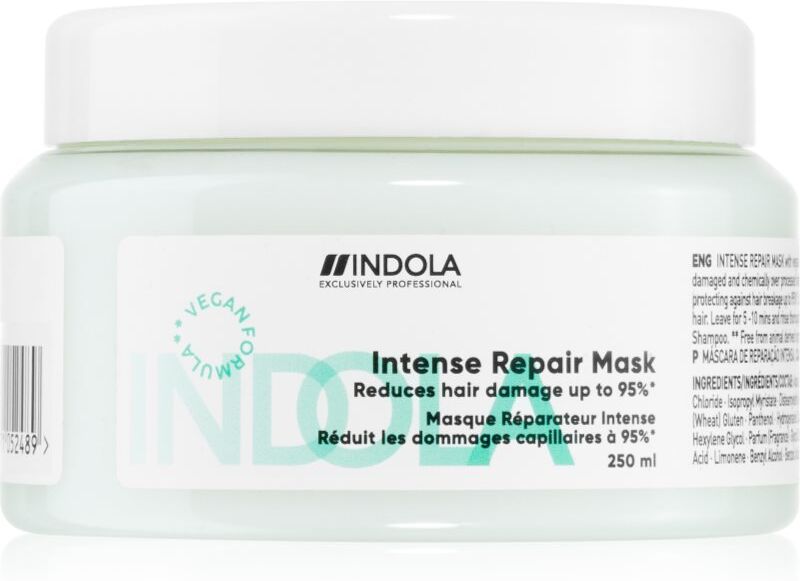
Indola Repair Intense Repair Mask masque fortifiant pour cheveux ultra-abîmés 250 mlIndola Repair Intense Repair Mask, 250 ml, Démêlants pour femme, Vos cheveux ont besoin d’un produit aux effets plus intenses que ceux offerts par les après-shampoing ou les baumes capillaires ? Optez donc pour le masque capillaire Indola Repair Intense Repair Mask. Il constituera un excellent complément à votre routine et, grâce à sa teneur élevée en actifs nourrissants destinés à pallier certains problèmes, redonnera vitalité et beauté à vos cheveux. Il pénètre en profondeur dans les fibres capillaires, les renforce, les nourrit intensément, favorise leur régénération et lisse leur surface. Irrésistiblement doux au toucher, les cheveux brillent de mille feux et sont plus résistants aux agressions extérieures. Le produit : facilite le coiffage, évitant ainsi d’endommager les cheveux renforce la fibre capillaire régénère les cheveux sur toute leur longueur offre une belle brillance aux cheveux Composition du produit : produit végétalien Mode d’emploi : Appliquez sur les cheveux lavés sur les longueurs et les pointes. Laissez agir pendant toute la durée indiquée sur l’emballage, puis rincez abondamment.15,90 €*Shipping: 3,45 €Secure redirect to the provider


-
How do you conjugate French adjectives?
In French, adjectives must agree in gender (masculine or feminine) and number (singular or plural) with the noun they modify. To conjugate a French adjective, you need to add the appropriate ending to match the gender and number of the noun it describes. For example, to make the adjective "petit" (small) agree with a masculine singular noun, you would use "petit." But if the noun is feminine singular, you would use "petite." And for a masculine plural noun, you would use "petits," and for a feminine plural noun, you would use "petites." **
-
How do you conjugate in Hebrew?
In Hebrew, verbs are conjugated based on the subject of the sentence and the tense of the action. There are different conjugation patterns for each tense (past, present, future) and for each subject (I, you, he/she/it, we, you all, they). The verb root remains the same, but the conjugation changes to match the subject and tense. Additionally, Hebrew verbs also change based on gender and number of the subject. Learning the conjugation patterns and practicing with different verbs is essential for mastering Hebrew verb conjugation. **
-
Can you help me conjugate avoir?
Sure! The verb "avoir" is conjugated as follows: - J'ai (I have) - Tu as (You have) - Il/Elle/On a (He/She/One has) - Nous avons (We have) - Vous avez (You have) - Ils/Elles ont (They have) **
-
How do you conjugate in French?
In French, verbs are conjugated to match the subject of the sentence, including the person (I, you, he/she, we, they) and the tense (present, past, future, etc.). To conjugate a regular verb in the present tense, you remove the infinitive ending (-er, -ir, -re) and add the appropriate ending for the subject (je, tu, il/elle, nous, vous, ils/elles). For example, for the verb "parler" (to speak), you would conjugate it as "je parle" (I speak), "tu parles" (you speak), "il/elle parle" (he/she speaks), "nous parlons" (we speak), "vous parlez" (you speak), "ils/elles parlent" (they speak). Irregular verbs have their own unique conjugation patterns that need to be memorized. **


How do you conjugate "perire" in Latin?
The verb "perire" in Latin is conjugated as follows in the present tense: - I perish: pereo - You perish: peris - He/she/it perishes: perit - We perish: perimus - You (plural) perish: peritis - They perish: pereunt **
How do you conjugate the Passé Composé?
To conjugate the Passé Composé in French, you typically use the auxiliary verb "avoir" or "être" followed by the past participle of the main verb. The choice between "avoir" and "être" depends on the verb being used and whether it is a transitive or intransitive verb. The past participle of regular -er verbs is formed by replacing the -er ending with -é, for -ir verbs you replace the -ir ending with -i, and for -re verbs you replace the -re ending with -u. Irregular verbs have unique past participle forms that need to be memorized. **
Top-Angebote
Products related to Conjugate:
-
BURTON LOW MAINTENANCE KITBURTON LOW MAINTENANCE KITHey rider, here you can find everything you've to know about the BURTON LOW MAINTENANCE KIT TOOL KIT. LOW MAINTENANCE KIT TOOL KIT BURTON The LOW MAINTENANCE KIT is a high quality BURTON UNISEX TOOL KIT. Its original price was 45,99&41,39 €*Shipping: 0,00 €Secure redirect to the provider
-
Yellow Professional Color Care Maintenance Shampoo shampoing pour cheveux colorés 500 mlYellow Professional Color Care Maintenance Shampoo, 500 ml, Shampoings pour femme, Vos cheveux ont besoin d’un produit aux effets plus intenses que ceux offerts par les après-shampoing ou les baumes capillaires ? Optez donc pour le masque capillaire Yellow Professional Color Care Maintenance Shampoo. Il constituera un excellent complément à votre routine et, grâce à sa teneur élevée en actifs nourrissants destinés à pallier certains problèmes, redonnera vitalité et beauté à vos cheveux. Il pénètre en profondeur dans les fibres capillaires, les renforce, les nourrit intensément, favorise leur régénération et lisse leur surface. Irrésistiblement doux au toucher, les cheveux brillent de mille feux et sont plus résistants aux agressions extérieures. Le produit : donne aux cheveux une subtile touche de couleur hydrate intensément régénère les cheveux sur toute leur longueur offre une belle brillance aux cheveux en ajustant la durée d'action, différentes intensités d’effet de couleur peuvent être obtenues Mode d’emploi : En fonction de l’intensité de la couleur souhaitée, augmentez ou diminuez le temps de pose.15,50 €*Shipping: 3,45 €Secure redirect to the provider
-
Elmex Repair Enamel Repair dentifrice 3x75 mlElmex Repair Enamel Repair, 3x75 ml, Dentifrices blanchissants mixte, Le dentifriceElmex Repair Enamel Repair est conçu pour délicatement blanchir vos dents. Son utilisation régulière supprime efficacement la pigmentation dentaire, elle vous rend votre sourire radieux. Le produit : blanchit les dents garantit le respect de l’émail dentaire présente une faible abrasivité revitalise et prend soin des gencives rafraîchit l’haleine nettoie les dents Mode d’emploi : Utilisez au moins 2 fois par jour. Nettoyez vos dents minutieusement pendant au moins 2 minutes.13,50 €*Shipping: 3,45 €Secure redirect to the provider
-
Swissdent Emergency Kit Red Ensemble de soins dentaires pour un blanchiment délicat et une protection de l'émail dentaireSwissdent Emergency Kit Red, , Dentifrices blanchissants mixte, Rien n’est plus joli qu’un beau sourire aux magnifiques dents blanches et en bonne santé. Le coffret cosmétique Swissdent Emergency Kit Red vous apportera les soins nécessaires pour avoir une belle dentition et vous donner l’envie de sourire à chaque instant. L'ensemble contient: White brosse à dents extra soft 1 pcs dentifrice blancheur intense 50 ml spray buccal 9 ml trousse de toilette 23 x 10 x 4 cm Le produit : élimine la plaque dentaire polit la surface des dents coffret avantageux protège contre la formation de plaque dentaire rafraîchit l’haleine nettoie les dents assure de rapidement retrouver une haleine intensément fraîche Mode d’emploi : Utilisez selon les besoins.22,50 €*Shipping: 3,45 €Secure redirect to the provider
-
When do you conjugate "avoir"?
The verb "avoir" is conjugated when talking about possession or to form compound tenses such as the passé composé. In these cases, "avoir" is conjugated according to the subject of the sentence. For example, "J'ai un chat" (I have a cat) or "Nous avons mangé" (We have eaten). **
-
How do you conjugate falloir?
The verb "falloir" is an impersonal verb, meaning it is only used in the third person singular. It is conjugated as "il faut" in the present tense, "il fallait" in the imperfect tense, and "il faudra" in the future tense. There is no need to conjugate it for different subjects, as it always remains in the third person singular form. **
-
How do you conjugate French adjectives?
In French, adjectives must agree in gender (masculine or feminine) and number (singular or plural) with the noun they modify. To conjugate a French adjective, you need to add the appropriate ending to match the gender and number of the noun it describes. For example, to make the adjective "petit" (small) agree with a masculine singular noun, you would use "petit." But if the noun is feminine singular, you would use "petite." And for a masculine plural noun, you would use "petits," and for a feminine plural noun, you would use "petites." **
-
How do you conjugate in Hebrew?
In Hebrew, verbs are conjugated based on the subject of the sentence and the tense of the action. There are different conjugation patterns for each tense (past, present, future) and for each subject (I, you, he/she/it, we, you all, they). The verb root remains the same, but the conjugation changes to match the subject and tense. Additionally, Hebrew verbs also change based on gender and number of the subject. Learning the conjugation patterns and practicing with different verbs is essential for mastering Hebrew verb conjugation. **
Similar search terms for Conjugate
-
Indola Repair Intense Repair Mask masque fortifiant pour cheveux ultra-abîmés 250 mlIndola Repair Intense Repair Mask, 250 ml, Démêlants pour femme, Vos cheveux ont besoin d’un produit aux effets plus intenses que ceux offerts par les après-shampoing ou les baumes capillaires ? Optez donc pour le masque capillaire Indola Repair Intense Repair Mask. Il constituera un excellent complément à votre routine et, grâce à sa teneur élevée en actifs nourrissants destinés à pallier certains problèmes, redonnera vitalité et beauté à vos cheveux. Il pénètre en profondeur dans les fibres capillaires, les renforce, les nourrit intensément, favorise leur régénération et lisse leur surface. Irrésistiblement doux au toucher, les cheveux brillent de mille feux et sont plus résistants aux agressions extérieures. Le produit : facilite le coiffage, évitant ainsi d’endommager les cheveux renforce la fibre capillaire régénère les cheveux sur toute leur longueur offre une belle brillance aux cheveux Composition du produit : produit végétalien Mode d’emploi : Appliquez sur les cheveux lavés sur les longueurs et les pointes. Laissez agir pendant toute la durée indiquée sur l’emballage, puis rincez abondamment.15,90 €*Shipping: 3,45 €Secure redirect to the provider
-
Can you help me conjugate avoir?
Sure! The verb "avoir" is conjugated as follows: - J'ai (I have) - Tu as (You have) - Il/Elle/On a (He/She/One has) - Nous avons (We have) - Vous avez (You have) - Ils/Elles ont (They have) **
-
How do you conjugate in French?
In French, verbs are conjugated to match the subject of the sentence, including the person (I, you, he/she, we, they) and the tense (present, past, future, etc.). To conjugate a regular verb in the present tense, you remove the infinitive ending (-er, -ir, -re) and add the appropriate ending for the subject (je, tu, il/elle, nous, vous, ils/elles). For example, for the verb "parler" (to speak), you would conjugate it as "je parle" (I speak), "tu parles" (you speak), "il/elle parle" (he/she speaks), "nous parlons" (we speak), "vous parlez" (you speak), "ils/elles parlent" (they speak). Irregular verbs have their own unique conjugation patterns that need to be memorized. **
-
How do you conjugate "perire" in Latin?
The verb "perire" in Latin is conjugated as follows in the present tense: - I perish: pereo - You perish: peris - He/she/it perishes: perit - We perish: perimus - You (plural) perish: peritis - They perish: pereunt **
-
How do you conjugate the Passé Composé?
To conjugate the Passé Composé in French, you typically use the auxiliary verb "avoir" or "être" followed by the past participle of the main verb. The choice between "avoir" and "être" depends on the verb being used and whether it is a transitive or intransitive verb. The past participle of regular -er verbs is formed by replacing the -er ending with -é, for -ir verbs you replace the -ir ending with -i, and for -re verbs you replace the -re ending with -u. Irregular verbs have unique past participle forms that need to be memorized. **
* All prices are inclusive of VAT and, if applicable, plus shipping costs. The offer information is based on the details provided by the respective shop and is updated through automated processes. Real-time updates do not occur, so deviations can occur in individual cases. ** Note: Parts of this content were created by AI.